The Charter of the French Language and its regulations govern the consultation of English-language content.

logo

Centre de recherche CERVO

Yves De Koninck

Contact & links

Yves.DeKoninck@neuro.ulaval.ca
Mailing Address

2601 Chemin de la Canardière
Québec (Québec)
G1J 2G3
Canada

F-4459
Office phone
(418) 663-5747
Lab website

Yves De Koninck

Ph.D.

Professor of psychiatry & Neuroscience at Laval University
Adjunct Professor of Pharmacology & Therapeutics at McGill University
Scientific Director, Quebec Mental Health Institute
Director of research, Quebec Integrated University Health and Social Services Centre
Director, Neurophotonics Center (www.neurophotonics.ca)
Scientific Director, Sentinel North Initiative
Fellow, Canadian Academy of Health Sciences
Fellow Royal Society of Canada
Canada Research Chair in Chronic Pain and Related Brain Disorders – Tier 1

Research axis:

Cellular and Molecular Neurosciences

Keywords

Neurophysiology, Sensory physiology, spinal cord, neurotransmission, pain, synaptic plasticity, computational neurosciences, membrane biophysics, non-linear microscopy, optogenetics, fluorescence techniques, inhibition, membrane transport, chloride homeostasis

Synaptic transmission: from chronic pain to Alzheimer’s disease

Yves De Koninck’s work focuses on the transmission of signals from one neuron to another, also called synaptic transmission, and the necessary balance between excitatory and inhibitory signals in the brain and spinal cord. His research has shown how a normally benign stimulus can turn into a pain signal, leading to the development of chronic pain.

One person in five will experience chronic pain in their lifetime, a proportion that increases with age. This is the leading cause of disability in the country, but few effective drugs exist to treat it, and there are several important side effects associated with their use. Dr. De Koninck’s team has shown that chronic pain is associated with a decrease in normal inhibition of pain signal transmission. Without this normal inhibition, a simple touch can cause pain, a phenomenon known as hyperalgesia.

Discoveries that lead to new avenues of pain treatment

Subsequent work by the De Koninck laboratory revealed that some molecules, including chloride ions and BDNF, play a key role in determining the excitability of neurons that transmit pain signals. These discoveries have led to the development of new pain management strategies, which also target the balance of chloride ions in neurons. More recently, his team has shown that they can partially reverse hyperalgesia in rats by preventing the recording of pain following its reactivation. This suggests that hyperalgesia shares some characteristics of memory, which can also be erased by similar mechanisms.

Understanding brain aging and autism

Research in the De Koninck laboratory has also shown that an imbalance in synaptic transmission in the brains of older rats is associated with decreased cognitive function and Alzheimer-like symptoms. These studies suggest that molecules that target this imbalance may be useful for treating age-related diseases. Professor De Koninck’s research has also suggested that autism may be caused, in part, by dysregulation in the transport of chloride ions, a research avenue that his team is pursuing.

Multidisciplinarity to push the limits of brain exploration

Dr. De Koninck is also recognized as a pioneer in applying optogenetic approaches, which use light to visualize, modulate, and study the activity of neurons in living animals. The combination of optical physics, genetic engineering, physiological and electrical recordings and computational approaches with knowledge of biology has allowed Dr. De Koninck’s team to deepen our understanding of synaptic transmission considerably.

Our research focuses on the physiological, pharmacological and anatomical bases of synaptic transmission, with a particular emphasis on cellular substrates of pathological conditions in the Central Nervous System (CNS). Our recent work focuses on three main themes:

  1. synaptic mechanisms in the sensory spinal cord and their plasticity during development and in experimental models of chronic pain;
  2. synaptic changes in the neocortex during ageing and Alzheimer’s disease;
  3. the impact of synaptic activity on the computational properties of neurons.

We use a wide array of approaches, including electrophysiological recording in vivo (micro-optrodes) and in vitro (patch clamp in slices), multiphoton and other non-linear imaging techniques, time-resolved fluorescence microscopy, in vivo optogenetics, tissue-based biochemical analysis, neural tracing and immunocytochemistry, and computational approaches.

The lab is also actively involved in the development of novel photonics technique development, including fluctuation analysis of fluorescent signals, fibreoptic-based probe development, novel microscopy techniques and neural modeling approaches.

[prix-par-tag]

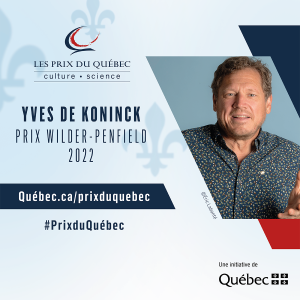
2022 Wilder-Penfield Prize, Government of Quebec
2020 Award for Education in Neuroscience, Society for Neuroscience
2019 Emily Gray Award, Biophysical Society
2018 Brockhouse Canada Prize
2016 Distinguished Career Award, Canadian Pain Society
2016 – 2030 Canada Research Chair in Chronic Pain and Related Brain Disorders (Tier 1)
2015 Royal Society of Canada, Fellow
2015 Université de Montréal, Honorary Doctorate
2014 Barbara Turnbull Foundation, Barbara Turnbull Award
2006 – 2015 Réseau québécois de recherche sur la douleur (RQRD), Scientific Director
2014 Québec Science, top 10 discoveries of the year
2013 Association francophone pour le savoir (ACFAS), Jacques-Rousseau Prize (multidiciplinarity)
2013 Canadian Academy of Health Sciences, Fellow
2013 Le Soleil, Top 10 discoveries of the year
2013 La Presse / Radio Canada, Personality of the week
2013 Association for the Study of Neurons and Diseases, Molecular Pain Award
2013 Canadians for Medical Research, Researcher of the Month (July)
2012 La Presse / Radio Canada, Personality of the week
2012 Québec Science, top 10 discoveries of the year
2010 – 2012 Canadian Association for Neurosciences, President
2011 British PainSociety, Patrick Wall Lecture
2007 – 2011 Fonds de la recherche en santé du Québec (FRSQ), FRSQ National Scholar
2003 – 2007 Fonds de la recherche en santé du Québec (FRSQ), FRSQ Senior Scholar
2004 Quebec Science, Top 10 discoveries of the year 2003
2001 Canadian Pain Society, Early Career Award
2000 – 2003 Fonds de la recherche en santé du Quebec (FRSQ), FRSQ Junior II Scholar
2000 Top 50 under 40, Radio Canada & Commerce Magazine
1998 Institut de recherche clinique de Montréal, Pfizer Travelling Fellow
1995 – 2000 Medical Research Council of Canada (MRC), MRC Scholar
1995 – 1999 Fonds de la recherche en santé du Québec (FRSQ), FRSQ Jr Scholar
1993 – 1994 Medical Research Council of Canada (MRC), Postdoctoral Fellowship
1991 – 1993 Medical Research Council of Canada (MRC), Postdoctoral Fellowship
1990 – 1991 Faculty of Medicine, Ph.D. Studentship, McGill University, Montreal, QC, Canada
1985 – 1990 Fonds de la recherche en santé du Québec (FRSQ), Ph.D. Studentship, McGill University, Montreal, QC, Canada
1985 – 1990 Fonds de l’aide et du soutien à la recherche du Quebec (FCAR), Ph.D. Studentship (declined)
1985 – 1989 Natural Sciences and Engineering Research Council (NSERC), Ph.D. Studentship (declined)

Publications

143 entries « ‹ 15 of 15 › »

Steven A Prescott; Yves De Koninck

Gain control of firing rate by shunting inhibition: roles of synaptic noise and dendritic saturation Journal Article

In: Proc Natl Acad Sci U S A, vol. 100, no. 4, pp. 2076–2081, 2003, ISSN: 0027-8424.

Links | BibTeX

Maria Antonietta Casu; T P Wong; Yves De Koninck; Alfredo Ribeiro-da-Silva; A Claudio Cuello

Aging causes a preferential loss of cholinergic innervation of characterized neocortical pyramidal neurons Journal Article

In: Cereb Cortex, vol. 12, no. 3, pp. 329–337, 2002, ISSN: 1047-3211.

Links | BibTeX

Steven A Prescott; Yves De Koninck

Four cell types with distinctive membrane properties and morphologies in lamina I of the spinal dorsal horn of the adult rat Journal Article

In: J Physiol, vol. 539, no. Pt 3, pp. 817–836, 2002, ISSN: 0022-3751.

Links | BibTeX

143 entries « ‹ 15 of 15 › »

News