Contact & links
2601 Chemin de la Canardière
Québec (Québec)
G1J 2G3
Canada
Yves De Koninck
Ph.D.
Professor of psychiatry & Neuroscience at Laval University
Adjunct Professor of Pharmacology & Therapeutics at McGill University
Scientific Director, Quebec Mental Health Institute
Director of research, Quebec Integrated University Health and Social Services Centre
Director, Neurophotonics Center (www.neurophotonics.ca)
Scientific Director, Sentinel North Initiative
Fellow, Canadian Academy of Health Sciences
Fellow Royal Society of Canada
Canada Research Chair in Chronic Pain and Related Brain Disorders – Tier 1
Research axis:
Cellular and Molecular Neurosciences
Neurophysiology, Sensory physiology, spinal cord, neurotransmission, pain, synaptic plasticity, computational neurosciences, membrane biophysics, non-linear microscopy, optogenetics, fluorescence techniques, inhibition, membrane transport, chloride homeostasis
Synaptic transmission: from chronic pain to Alzheimer’s disease
Yves De Koninck’s work focuses on the transmission of signals from one neuron to another, also called synaptic transmission, and the necessary balance between excitatory and inhibitory signals in the brain and spinal cord. His research has shown how a normally benign stimulus can turn into a pain signal, leading to the development of chronic pain.
One person in five will experience chronic pain in their lifetime, a proportion that increases with age. This is the leading cause of disability in the country, but few effective drugs exist to treat it, and there are several important side effects associated with their use. Dr. De Koninck’s team has shown that chronic pain is associated with a decrease in normal inhibition of pain signal transmission. Without this normal inhibition, a simple touch can cause pain, a phenomenon known as hyperalgesia.
Discoveries that lead to new avenues of pain treatment
Subsequent work by the De Koninck laboratory revealed that some molecules, including chloride ions and BDNF, play a key role in determining the excitability of neurons that transmit pain signals. These discoveries have led to the development of new pain management strategies, which also target the balance of chloride ions in neurons. More recently, his team has shown that they can partially reverse hyperalgesia in rats by preventing the recording of pain following its reactivation. This suggests that hyperalgesia shares some characteristics of memory, which can also be erased by similar mechanisms.
Understanding brain aging and autism
Research in the De Koninck laboratory has also shown that an imbalance in synaptic transmission in the brains of older rats is associated with decreased cognitive function and Alzheimer-like symptoms. These studies suggest that molecules that target this imbalance may be useful for treating age-related diseases. Professor De Koninck’s research has also suggested that autism may be caused, in part, by dysregulation in the transport of chloride ions, a research avenue that his team is pursuing.
Multidisciplinarity to push the limits of brain exploration
Dr. De Koninck is also recognized as a pioneer in applying optogenetic approaches, which use light to visualize, modulate, and study the activity of neurons in living animals. The combination of optical physics, genetic engineering, physiological and electrical recordings and computational approaches with knowledge of biology has allowed Dr. De Koninck’s team to deepen our understanding of synaptic transmission considerably.
Our research focuses on the physiological, pharmacological and anatomical bases of synaptic transmission, with a particular emphasis on cellular substrates of pathological conditions in the Central Nervous System (CNS). Our recent work focuses on three main themes:
- synaptic mechanisms in the sensory spinal cord and their plasticity during development and in experimental models of chronic pain;
- synaptic changes in the neocortex during ageing and Alzheimer’s disease;
- the impact of synaptic activity on the computational properties of neurons.
We use a wide array of approaches, including electrophysiological recording in vivo (micro-optrodes) and in vitro (patch clamp in slices), multiphoton and other non-linear imaging techniques, time-resolved fluorescence microscopy, in vivo optogenetics, tissue-based biochemical analysis, neural tracing and immunocytochemistry, and computational approaches.
The lab is also actively involved in the development of novel photonics technique development, including fluctuation analysis of fluorescent signals, fibreoptic-based probe development, novel microscopy techniques and neural modeling approaches.
[prix-par-tag]
2014 Barbara Turnbull Foundation, Barbara Turnbull Award
2006 – 2015 Réseau québécois de recherche sur la douleur (RQRD), Scientific Director
2014 Québec Science, top 10 discoveries of the year
2013 Association francophone pour le savoir (ACFAS), Jacques-Rousseau Prize (multidiciplinarity)
2013 Canadian Academy of Health Sciences, Fellow
2013 Le Soleil, Top 10 discoveries of the year
2013 La Presse / Radio Canada, Personality of the week
2013 Association for the Study of Neurons and Diseases, Molecular Pain Award
2013 Canadians for Medical Research, Researcher of the Month (July)
2012 La Presse / Radio Canada, Personality of the week
2012 Québec Science, top 10 discoveries of the year
2010 – 2012 Canadian Association for Neurosciences, President
2011 British PainSociety, Patrick Wall Lecture
2007 – 2011 Fonds de la recherche en santé du Québec (FRSQ), FRSQ National Scholar
2003 – 2007 Fonds de la recherche en santé du Québec (FRSQ), FRSQ Senior Scholar
2004 Quebec Science, Top 10 discoveries of the year 2003
2001 Canadian Pain Society, Early Career Award
2000 – 2003 Fonds de la recherche en santé du Quebec (FRSQ), FRSQ Junior II Scholar
2000 Top 50 under 40, Radio Canada & Commerce Magazine
1998 Institut de recherche clinique de Montréal, Pfizer Travelling Fellow
1995 – 2000 Medical Research Council of Canada (MRC), MRC Scholar
1995 – 1999 Fonds de la recherche en santé du Québec (FRSQ), FRSQ Jr Scholar
1993 – 1994 Medical Research Council of Canada (MRC), Postdoctoral Fellowship
1991 – 1993 Medical Research Council of Canada (MRC), Postdoctoral Fellowship
1990 – 1991 Faculty of Medicine, Ph.D. Studentship, McGill University, Montreal, QC, Canada
1985 – 1990 Fonds de la recherche en santé du Québec (FRSQ), Ph.D. Studentship, McGill University, Montreal, QC, Canada
1985 – 1990 Fonds de l’aide et du soutien à la recherche du Quebec (FCAR), Ph.D. Studentship (declined)
1985 – 1989 Natural Sciences and Engineering Research Council (NSERC), Ph.D. Studentship (declined)
Publications
Yves De Koninck; Johanna Alonso; Stéphane Bancelin; Jean-Claude Béïque; Erik Bélanger; Catherine Bouchard; Marco Canossa; Johan Chaniot; Daniel Choquet; Marie-Ève Crochetière; Nanke Cui; Lydia Danglot; Paul De Koninck; Anna Devor; Mathieu Ducros; Angela M Getz; Mohamed Haouat; Iván Coto Hernández; Nate Jowett; Iason Keramidis; Céline Larivière-Loiselle; Flavie Lavoie-Cardinal; Harold D MacGillavry; Asiye Malkoç; Mattia Mancinelli; Pierre Marquet; Steven Minderler; Maxime Moreaud; U Valentin Nägerl; Katerina Papanikolopoulou; Marie-Eve Paquet; Lorenzo Pavesi; David Perrais; Romain Sansonetti; Martin Thunemann; Beatrice Vignoli; Jenny Yau; Clara Zaccaria
Understanding the nervous system: lessons from Frontiers in Neurophotonics Journal Article
In: Neurophotonics, vol. 11, no. 1, pp. 014415, 2024, ISSN: 2329-423X.
@article{pmid38545127,
title = {Understanding the nervous system: lessons from Frontiers in Neurophotonics},
author = {Yves De Koninck and Johanna Alonso and Stéphane Bancelin and Jean-Claude Béïque and Erik Bélanger and Catherine Bouchard and Marco Canossa and Johan Chaniot and Daniel Choquet and Marie-Ève Crochetière and Nanke Cui and Lydia Danglot and Paul De Koninck and Anna Devor and Mathieu Ducros and Angela M Getz and Mohamed Haouat and Iván Coto Hernández and Nate Jowett and Iason Keramidis and Céline Larivière-Loiselle and Flavie Lavoie-Cardinal and Harold D MacGillavry and Asiye Malkoç and Mattia Mancinelli and Pierre Marquet and Steven Minderler and Maxime Moreaud and U Valentin Nägerl and Katerina Papanikolopoulou and Marie-Eve Paquet and Lorenzo Pavesi and David Perrais and Romain Sansonetti and Martin Thunemann and Beatrice Vignoli and Jenny Yau and Clara Zaccaria},
doi = {10.1117/1.NPh.11.1.014415},
issn = {2329-423X},
year = {2024},
date = {2024-01-01},
journal = {Neurophotonics},
volume = {11},
number = {1},
pages = {014415},
abstract = {The Frontiers in Neurophotonics Symposium is a biennial event that brings together neurobiologists and physicists/engineers who share interest in the development of leading-edge photonics-based approaches to understand and manipulate the nervous system, from its individual molecular components to complex networks in the intact brain. In this Community paper, we highlight several topics that have been featured at the symposium that took place in October 2022 in Québec City, Canada.},
keywords = {},
pubstate = {published},
tppubtype = {article}
}
Yves De Koninck; Paul De Koninck; Anna Devor; Flavie Lavoie-Cardinal
Special Section Guest Editorial: Frontiers in Neurophotonics Journal Article
In: Neurophotonics, vol. 11, no. 1, pp. 014401, 2024, ISSN: 2329-423X.
@article{pmid38550388,
title = {Special Section Guest Editorial: Frontiers in Neurophotonics},
author = {Yves De Koninck and Paul De Koninck and Anna Devor and Flavie Lavoie-Cardinal},
doi = {10.1117/1.NPh.11.1.014401},
issn = {2329-423X},
year = {2024},
date = {2024-01-01},
journal = {Neurophotonics},
volume = {11},
number = {1},
pages = {014401},
abstract = {The editorial presents the two-part Special Section on Frontiers in Neurophotonics.},
keywords = {},
pubstate = {published},
tppubtype = {article}
}
Iason Keramidis; Brendan B McAllister; Julien Bourbonnais; Feng Wang; Dominique Isabel; Edris Rezaei; Romain Sansonetti; Phil Degagne; Justin P Hamel; Mojtaba Nazari; Samsoon Inayat; Jordan C Dudley; Annie Barbeau; Lionel Froux; Marie-Eve Paquet; Antoine G Godin; Majid H Mohajerani; Yves De Koninck
Restoring neuronal chloride extrusion reverses cognitive decline linked to Alzheimer’s disease mutations Journal Article
In: Brain, vol. 146, no. 12, pp. 4903–4915, 2023, ISSN: 1460-2156.
@article{pmid37551444,
title = {Restoring neuronal chloride extrusion reverses cognitive decline linked to Alzheimer's disease mutations},
author = {Iason Keramidis and Brendan B McAllister and Julien Bourbonnais and Feng Wang and Dominique Isabel and Edris Rezaei and Romain Sansonetti and Phil Degagne and Justin P Hamel and Mojtaba Nazari and Samsoon Inayat and Jordan C Dudley and Annie Barbeau and Lionel Froux and Marie-Eve Paquet and Antoine G Godin and Majid H Mohajerani and Yves De Koninck},
doi = {10.1093/brain/awad250},
issn = {1460-2156},
year = {2023},
date = {2023-12-01},
journal = {Brain},
volume = {146},
number = {12},
pages = {4903--4915},
abstract = {Disinhibition during early stages of Alzheimer's disease is postulated to cause network dysfunction and hyperexcitability leading to cognitive deficits. However, the underlying molecular mechanism remains unknown. Here we show that, in mouse lines carrying Alzheimer's disease-related mutations, a loss of neuronal membrane potassium-chloride cotransporter KCC2, responsible for maintaining the robustness of GABAA-mediated inhibition, occurs pre-symptomatically in the hippocampus and prefrontal cortex. KCC2 downregulation was inversely correlated with the age-dependent increase in amyloid-β 42 (Aβ42). Acute administration of Aβ42 caused a downregulation of membrane KCC2. Loss of KCC2 resulted in impaired chloride homeostasis. Preventing the decrease in KCC2 using long term treatment with CLP290 protected against deterioration of learning and cortical hyperactivity. In addition, restoring KCC2, using short term CLP290 treatment, following the transporter reduction effectively reversed spatial memory deficits and social dysfunction, linking chloride dysregulation with Alzheimer's disease-related cognitive decline. These results reveal KCC2 hypofunction as a viable target for treatment of Alzheimer's disease-related cognitive decline; they confirm target engagement, where the therapeutic intervention takes place, and its effectiveness.},
keywords = {},
pubstate = {published},
tppubtype = {article}
}
Marco Battaglia; Orlane Rossignol; Louis-Etienne Lorenzo; Jasmin Deguire; Antoine G Godin; Francesca R D’Amato; Yves De Koninck
Enhanced harm detection following maternal separation: Transgenerational transmission and reversibility by inhaled amiloride Journal Article
In: Sci Adv, vol. 9, no. 40, pp. eadi8750, 2023, ISSN: 2375-2548.
@article{pmid37792939,
title = {Enhanced harm detection following maternal separation: Transgenerational transmission and reversibility by inhaled amiloride},
author = {Marco Battaglia and Orlane Rossignol and Louis-Etienne Lorenzo and Jasmin Deguire and Antoine G Godin and Francesca R D'Amato and Yves De Koninck},
doi = {10.1126/sciadv.adi8750},
issn = {2375-2548},
year = {2023},
date = {2023-10-01},
journal = {Sci Adv},
volume = {9},
number = {40},
pages = {eadi8750},
abstract = {Early-life adversities are associated with altered defensive responses. Here, we demonstrate that the repeated cross-fostering (RCF) paradigm of early maternal separation is associated with enhancements of distinct homeostatic reactions: hyperventilation in response to hypercapnia and nociceptive sensitivity, among the first generation of RCF-exposed animals, as well as among two successive generations of their normally reared offspring, through matrilineal transmission. Parallel enhancements of acid-sensing ion channel 1 (ASIC1), ASIC2, and ASIC3 messenger RNA transcripts were detected transgenerationally in central neurons, in the medulla oblongata, and in periaqueductal gray matter of RCF-lineage animals. A single, nebulized dose of the ASIC-antagonist amiloride renormalized respiratory and nociceptive responsiveness across the entire RCF lineage. These findings reveal how, following an early-life adversity, a biological memory reducible to a molecular sensor unfolds, shaping adaptation mechanisms over three generations. Our findings are entwined with multiple correlates of human anxiety and pain conditions and suggest nebulized amiloride as a therapeutic avenue.},
keywords = {},
pubstate = {published},
tppubtype = {article}
}
Cléophace Akitegetse; Thomas Charland; Mireille Quémener; Charles Gora; Véronique Rioux; Michel Piché; Yves De Koninck; Martin Lévesque; Daniel C Côté
Millimetric scale two-photon Bessel-Gauss beam light sheet microscopy with three-axis isotropic resolution using an axicon lens Journal Article
In: Neurophotonics, vol. 10, no. 3, pp. 035002, 2023, ISSN: 2329-423X.
@article{pmid37362387,
title = {Millimetric scale two-photon Bessel-Gauss beam light sheet microscopy with three-axis isotropic resolution using an axicon lens},
author = {Cléophace Akitegetse and Thomas Charland and Mireille Quémener and Charles Gora and Véronique Rioux and Michel Piché and Yves De Koninck and Martin Lévesque and Daniel C Côté},
doi = {10.1117/1.NPh.10.3.035002},
issn = {2329-423X},
year = {2023},
date = {2023-07-01},
journal = {Neurophotonics},
volume = {10},
number = {3},
pages = {035002},
abstract = {SIGNIFICANCE: Typical light sheet microscopes suffer from artifacts related to the geometry of the light sheet. One main inconvenience is the non-uniform thickness of the light sheet obtained with a Gaussian laser beam.nnAIM: We developed a two-photon light sheet microscope that takes advantage of a thin and long Bessel-Gauss beam illumination to increase the sheet extent without compromising the resolution.nnAPPROACH: We use an axicon lens placed directly at the output of an amplified femtosecond laser to produce a long Bessel-Gauss beam on the sample. We studied the dopaminergic system and its projections in a whole cleared mouse brain.nnRESULTS: Our light sheet microscope allows an isotropic resolution of in all three axes of the scanned volume while keeping a millimetric-sized field of view, and a fast acquisition rate of up to . With slight modifications to the optical setup, the sheet extent can be increased to 6 mm.nnCONCLUSION: The proposed system's sheet extent and resolution surpass currently available systems, enabling the fast imaging of large specimens.},
keywords = {},
pubstate = {published},
tppubtype = {article}
}
Mohamad Feshki; Sylvain Martel; Yves De Koninck; Benoit Gosselin
Improving flat fluorescence microscopy in scattering tissue through deep learning strategies Journal Article
In: Opt Express, vol. 31, no. 14, pp. 23008–23026, 2023, ISSN: 1094-4087.
@article{pmid37475396,
title = {Improving flat fluorescence microscopy in scattering tissue through deep learning strategies},
author = {Mohamad Feshki and Sylvain Martel and Yves De Koninck and Benoit Gosselin},
doi = {10.1364/OE.489677},
issn = {1094-4087},
year = {2023},
date = {2023-07-01},
journal = {Opt Express},
volume = {31},
number = {14},
pages = {23008--23026},
abstract = {Intravital microscopy in small animals growingly contributes to the visualization of short- and long-term mammalian biological processes. Miniaturized fluorescence microscopy has revolutionized the observation of live animals' neural circuits. The technology's ability to further miniaturize to improve freely moving experimental settings is limited by its standard lens-based layout. Typical miniature microscope designs contain a stack of heavy and bulky optical components adjusted at relatively long distances. Computational lensless microscopy can overcome this limitation by replacing the lenses with a simple thin mask. Among other critical applications, Flat Fluorescence Microscope (FFM) holds promise to allow for real-time brain circuits imaging in freely moving animals, but recent research reports show that the quality needs to be improved, compared with imaging in clear tissue, for instance. Although promising results were reported with mask-based fluorescence microscopes in clear tissues, the impact of light scattering in biological tissue remains a major challenge. The outstanding performance of deep learning (DL) networks in computational flat cameras and imaging through scattering media studies motivates the development of deep learning models for FFMs. Our holistic ray-tracing and Monte Carlo FFM computational model assisted us in evaluating deep scattering medium imaging with DL techniques. We demonstrate that physics-based DL models combined with the classical reconstruction technique of the alternating direction method of multipliers (ADMM) perform a fast and robust image reconstruction, particularly in the scattering medium. The structural similarity indexes of the reconstructed images in scattering media recordings were increased by up to 20% compared with the prevalent iterative models. We also introduce and discuss the challenges of DL approaches for FFMs under physics-informed supervised and unsupervised learning.},
keywords = {},
pubstate = {published},
tppubtype = {article}
}
Marco Battaglia; Cornelius B Groenewald; Fiona Campbell; Simona Scaini; Yves De Koninck; Jennifer Stinson; Patrick D Quinn
We need to talk: The urgent conversation on chronic pain, mental health, prescribing patterns and the opioid crisis Journal Article
In: J Psychopharmacol, vol. 37, no. 5, pp. 437–448, 2023, ISSN: 1461-7285.
@article{pmid37171242,
title = {We need to talk: The urgent conversation on chronic pain, mental health, prescribing patterns and the opioid crisis},
author = {Marco Battaglia and Cornelius B Groenewald and Fiona Campbell and Simona Scaini and Yves De Koninck and Jennifer Stinson and Patrick D Quinn},
doi = {10.1177/02698811221144635},
issn = {1461-7285},
year = {2023},
date = {2023-05-01},
journal = {J Psychopharmacol},
volume = {37},
number = {5},
pages = {437--448},
abstract = {The opioid crisis' pathways from first exposure onwards to eventual illnesses and fatalities are multiple, intertwined and difficult to dissect. Here, we offer a multidisciplinary appraisal of the relationships among mental health, chronic pain, prescribing patterns worldwide and the opioid crisis. Because the opioid crisis' toll is especially harsh on young people, emphasis is given on data regarding the younger strata of the population. Because analgesic opioid prescription constitute a recognised entry point towards misuse, opioid use disorder, and ultimately overdose, prescribing patterns across different countries are examined as a modifiable hazard factor along these pathways of risk. Psychiatrists are called to play a more compelling role in this urgent conversation, as they are uniquely placed to provide synthesis and lead action among the different fields of knowledge and care that lie at the crossroads of the opioid crisis. Psychiatrists are also ideally positioned to gauge and disseminate the foundations for diagnosis and clinical management of mental conditions associated with chronic pain, including the identification of hazardous and protective factors. It is our hope to spark more interdisciplinary exchanges and encourage psychiatrists worldwide to become leaders in an urgent conversation with interlocutors from the clinical and basic sciences, policy makers and stakeholders including clients and their families.},
keywords = {},
pubstate = {published},
tppubtype = {article}
}
Marc López-Cano; Joan Font; Ester Aso; Kristoffer Sahlholm; Gisela Cabré; Jesús Giraldo; Yves De Koninck; Jordi Hernando; Amadeu Llebaria; Víctor Fernández-Dueñas; Francisco Ciruela
Remote local photoactivation of morphine produces analgesia without opioid-related adverse effects Journal Article
In: Br J Pharmacol, vol. 180, no. 7, pp. 958–974, 2023, ISSN: 1476-5381.
@article{pmid34363210,
title = {Remote local photoactivation of morphine produces analgesia without opioid-related adverse effects},
author = {Marc López-Cano and Joan Font and Ester Aso and Kristoffer Sahlholm and Gisela Cabré and Jesús Giraldo and Yves De Koninck and Jordi Hernando and Amadeu Llebaria and Víctor Fernández-Dueñas and Francisco Ciruela},
doi = {10.1111/bph.15645},
issn = {1476-5381},
year = {2023},
date = {2023-04-01},
journal = {Br J Pharmacol},
volume = {180},
number = {7},
pages = {958--974},
abstract = {BACKGROUND AND PURPOSE: Opioid-based drugs are the gold standard medicines for pain relief. However, tolerance and several side effects (i.e. constipation and dependence) may occur upon chronic opioid administration. Photopharmacology is a promising approach to improve the benefit/risk profiles of these drugs. Thus, opioids can be locally activated with high spatiotemporal resolution, potentially minimizing systemic-mediated adverse effects. Here, we aimed at developing a morphine photo-derivative (photocaged morphine), which can be activated upon light irradiation both in vitro and in vivo.nnEXPERIMENTAL APPROACH: Light-dependent activity of pc-morphine was assessed in cell-based assays (intracellular calcium accumulation and electrophysiology) and in mice (formalin animal model of pain). In addition, tolerance, constipation and dependence were investigated in vivo using experimental paradigms.nnKEY RESULTS: In mice, pc-morphine was able to elicit antinociceptive effects, both using external light-irradiation (hind paw) and spinal cord implanted fibre-optics. In addition, remote morphine photoactivation was devoid of common systemic opioid-related undesired effects, namely, constipation, tolerance to the analgesic effects, rewarding effects and naloxone-induced withdrawal.nnCONCLUSION AND IMPLICATIONS: Light-dependent opioid-based drugs may allow effective analgesia without the occurrence of tolerance or the associated and severe opioid-related undesired effects.nnLINKED ARTICLES: This article is part of a themed issue on Advances in Opioid Pharmacology at the Time of the Opioid Epidemic. To view the other articles in this section visit http://onlinelibrary.wiley.com/doi/10.1111/bph.v180.7/issuetoc.},
keywords = {},
pubstate = {published},
tppubtype = {article}
}
Melissa L Perreault; Malcolm King; Chelsea Gabel; Christopher J Mushquash; Yves De Koninck; Ashley Lawson; Caterina Marra; Caroline Ménard; Jennie Z Young; Judy Illes
An Indigenous Lens on Priorities for the Canadian Brain Research Strategy Journal Article
In: Can J Neurol Sci, vol. 50, no. 1, pp. 96–98, 2023, ISSN: 0317-1671.
@article{pmid34847973,
title = {An Indigenous Lens on Priorities for the Canadian Brain Research Strategy},
author = {Melissa L Perreault and Malcolm King and Chelsea Gabel and Christopher J Mushquash and Yves De Koninck and Ashley Lawson and Caterina Marra and Caroline Ménard and Jennie Z Young and Judy Illes},
doi = {10.1017/cjn.2021.501},
issn = {0317-1671},
year = {2023},
date = {2023-01-01},
journal = {Can J Neurol Sci},
volume = {50},
number = {1},
pages = {96--98},
keywords = {},
pubstate = {published},
tppubtype = {article}
}
Noosha Yousefpour; Samantha Locke; Haley Deamond; Chengyang Wang; Lucas Marques; Manon St-Louis; Johanne Ouellette; Arkady Khoutorsky; Yves De Koninck; Alfredo Ribeiro-da-Silva
Time-dependent and selective microglia-mediated removal of spinal synapses in neuropathic pain Journal Article
In: Cell Rep, vol. 42, no. 1, pp. 112010, 2023, ISSN: 2211-1247.
@article{pmid36656715,
title = {Time-dependent and selective microglia-mediated removal of spinal synapses in neuropathic pain},
author = {Noosha Yousefpour and Samantha Locke and Haley Deamond and Chengyang Wang and Lucas Marques and Manon St-Louis and Johanne Ouellette and Arkady Khoutorsky and Yves De Koninck and Alfredo Ribeiro-da-Silva},
doi = {10.1016/j.celrep.2023.112010},
issn = {2211-1247},
year = {2023},
date = {2023-01-01},
journal = {Cell Rep},
volume = {42},
number = {1},
pages = {112010},
abstract = {Neuropathic pain is a debilitating condition resulting from damage to the nervous system. Imbalance of spinal excitation and inhibition has been proposed to contribute to neuropathic pain. However, the structural basis of this imbalance remains unknown. Using a preclinical model of neuropathic pain, we show that microglia selectively engulf spinal synapses that are formed by central neurons and spare those of peripheral sensory neurons. Furthermore, we reveal that removal of inhibitory and excitatory synapses exhibits distinct temporal patterns, in which microglia-mediated inhibitory synapse removal precedes excitatory synapse removal. We also find selective and gradual increase in complement depositions on dorsal horn synapses that corresponds to the temporal pattern of microglial synapse pruning activity and type-specific synapse loss. Together, these results define a specific role for microglia in the progression of neuropathic pain pathogenesis and implicate these immune cells in structural remodeling of dorsal horn circuitry.},
keywords = {},
pubstate = {published},
tppubtype = {article}
}
News
Yves De Koninck wins the Margolese National Brain Disorders Prize
CERVO Participation in the First Q2 Summer School
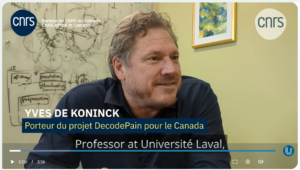
Yves De Koninck presents the DecodePain International Research Project
Dr David Cohen, featured speaker of the Tête-à-tête conference presented by the CERVO Foundation
Interview with Yves De Koninck on Radio-Canada: Shingles vaccine may reduce risk of Alzheimer’s disease
Mal invisible, a series about chronic pain to view on Savoir média
The biological memory of a stressful event can be passed on to offspring
Article in Québec Science about Chronic Pain with Yves De Koninck
Article in Le Soleil about a new therapeutic approach to Alzheimer’s disease
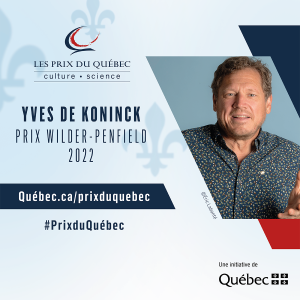
Yves De Koninck wins the Wilder Penfield award


![CNRS Canada. (2025, 12 mars). IRP DecodePain. [Vidéo]. Canal-U. https://doi.org/10.60527/247m-jt26. (Consultée le 13 mars 2025)](https://cervo.ulaval.ca/wp-content/uploads/2025/03/ydk-decode-pain-canal-u-300x170.png)